Hong Kong’s Medialink plans paid internships as Asia’s IP boom opens new licensing opportunities
Asian entertainment businesses are expanding the commercial value of popular characters and stories beyond their original formats.
By Cheuk Hei Chan
October 2026
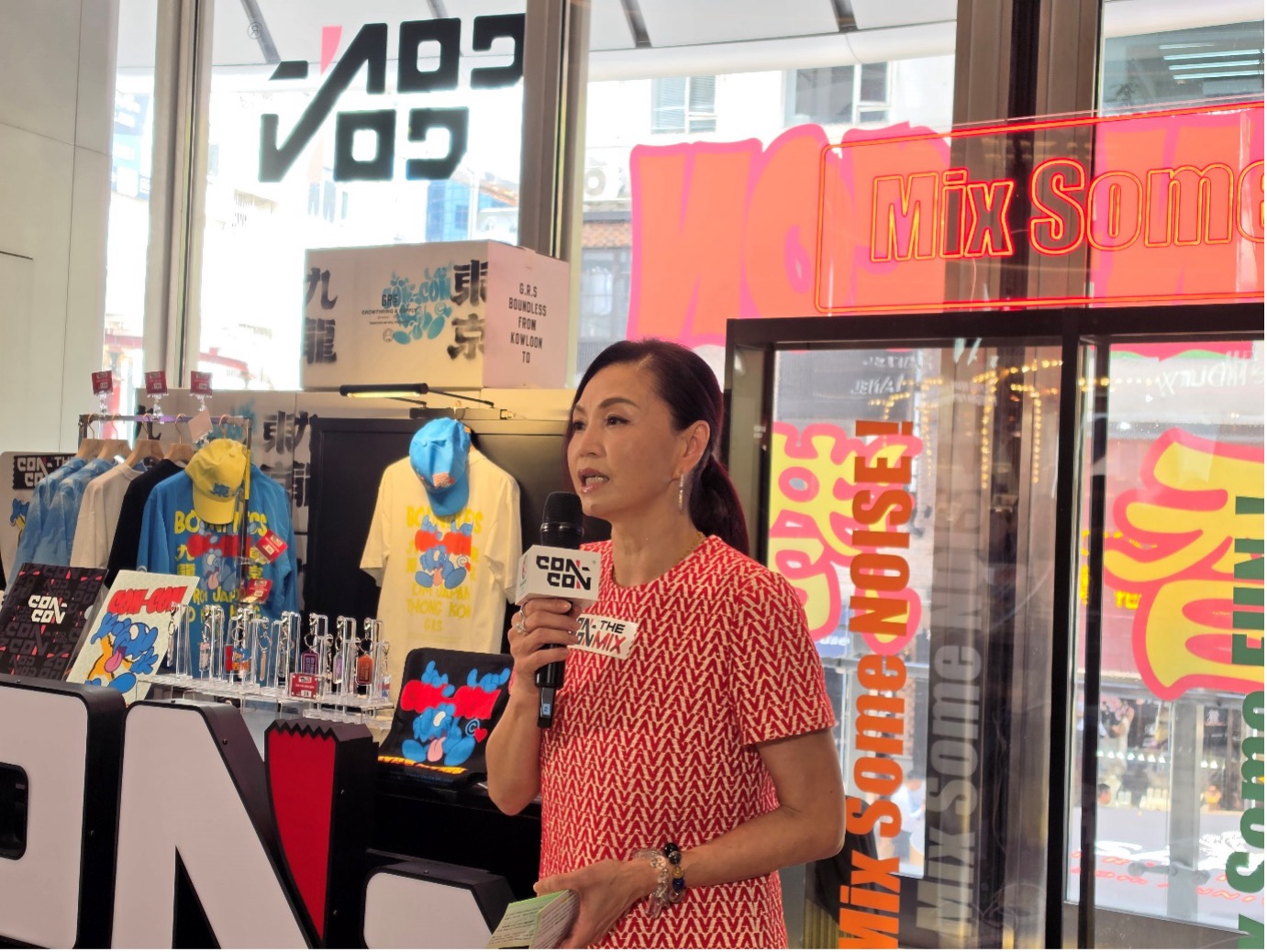
Medialink’s CEO announces a program that teaches university students IP-related knowledge at a pop-culture event in Hong Kong.
Hong Kong’s Medialink Group plans to launch paid internships for university students, seeking to cultivate talent in entertainment intellectual property as Asian characters and animation gain international popularity and create new opportunities for licensing and commercialization.
The program, known as the Con-Con University Student Ambassador Program, is expected to run during summer and winter university breaks each year, offering experience in marketing, publishing, brand licensing and event management, the media content distributor and brand licensing company’s founder and chief executive Lovinia Chiu said.
The program announcement follows a similarly named Medialink event in April for entertainment franchises, music and pop culture under the theme of cross-industry collaboration.
Participants will work alongside industry professionals with the opportunity to land a position at the company after graduation.
Chiu said growing the talent pool has long been challenging, while public awareness of IP management remained limited. She added that details of the program will be announced soon.
The initiative comes as Asian entertainment businesses increasingly expand the commercial value of popular characters and stories beyond their original formats, generating revenue through merchandise, brand collaborations, exhibitions and other consumer experiences.
The global IP industry gained attention in the equity market after COVID-19 as major names posted stronger revenue growth with share prices rising anywhere from 50% to 490% between 2022 and 2025.
In a report published last year, Bank of America attributed the rise of the IP industry to Gen Z, who proactively seeks emotional value in products.
According to Licensing International, global retail sales of licensed merchandise and services rose 5.45% to US$389.8 billion in 2025, outpacing the broader retail market’s 4.52% growth.
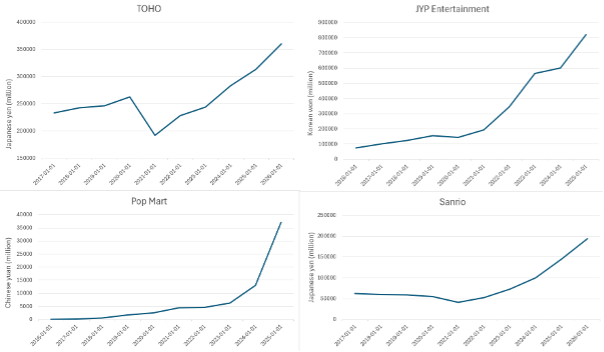
Revenue surges for major players since around 2022 (Image: Cheuk Hei Chan).
Maura Regan, president of Licensing International, highlighted opportunities across categories including art, experiences, sports, gaming and food and beverage, reflecting the breadth of opportunity across licensing.
North Asia, which includes China, Japan and South Korea, was the fastest-growing region at 14.1%. Worldwide sales associated with character and entertainment licensing increased 8% to US$161.8 billion in the same period.
Japan has built an international market around established animation franchises. Its anime market rose 14.8% to a record 3.8 trillion yen in 2024, according to the Association of Japanese Animations. Overseas business grew 26% to 2.1 trillion yen, surpassing domestic sales.
South Korea has taken a different approach with its K-pop and TV dramas. Its content exports increased 5.7% to US$14.9 billion in 2025, while K-pop album exports jumped 125% from a year earlier to a record US$257.48 million in the first half of this year, official data shows.
Meanwhile, Chinese companies have demonstrated how original characters can reach international consumers through collectible merchandise without first establishing themselves in films or television amid a supply-driven dynamic.
A successful example in Asia is Labubu, which generated 8.2 million yuan in income every day in 2024 for Pop Mart, the company behind the character, according to its financial report.
A 2025 survey conducted by Morgan Stanley showed that the IP collectibles market has evolved into a mainstream consumer segment, with more than 60% of respondents in China having purchased IP merchandise in the past year.
“IP/character collectibles represent a distinct category within the entertainment industry,” the investment bank wrote. “IP collectibles deliver entertainment through ownership, collection, and social interaction. The act of purchasing, curating, and sharing these items creates a participatory experience,” it added.
For Hong Kong, these developments have renewed attention on its ambition to become a regional IP trading center.
Chiu identified cross-border rights trading as one of the city’s principal strengths, citing its established legal framework and professional services as foundations for connecting overseas rights holders with businesses and helping Chinese entertainment properties reach overseas markets.
The Hong Kong International Licensing Show in April, which attracted over 21,000 buyers, was one of the city’s efforts to show its international trade strength. During the show, Hong Kong exhibitor Postgal Workshop reached an agreement with Malaysia based M&M Creations Holdings Sdh. Bhd., involving its IP “Din Dong”, with the collaboration estimated to be worth over US$200,000.
“In alignment with the national 15th Five-Year Plan, Hong Kong will continue to actively develop its role as a regional intellectual property trading hub, further enhancing its international competitiveness in the cultural and creative industries and IP transactions,” said Jenny Hoo, the deputy executive director of HKTDC.
The government also plans to launch the Hong Kong Intellectual Property Academy in the fourth quarter of 2026 to provide more systematic and on-the-job training in IP. Chiu was appointed to its steering committee in September.
“Talent needs to be nurtured before an IP trading hub can be built,” Chiu said.

Talent needs to be nurtured before an IP trading hub can be built.

Shenzhen marks New Year’s day with parade as tourist spending booms
More than 160,000 people gathered in Shenzhen last week to watch a New Year’s Day parade with more than 1,500 performers on Festival Avenue in Futian, as the city saw an overall boom in tourist spending during the holiday.
Afro Boom: South African Amapiano and Afro House find a beat in China
Shoulders roll, hips sway and feet tap as strangers are united in motion. The only common language at the Shenzhen Afro Pulz Dance Camp is rhythm.

Burned out Chinese teachers struggle with school responsibilities
It’s after 10pm and the city streetlights have long been on in southeastern China. Melisa returns home, exhaustion written on her face. All she wants is a shower