Tencent expands WorkBuddy to more markets as Chinese AI models challenge U.S. rivals
Chinese AI platforms closing the gap in performance benchmarks
By Cheuk Hei Chan
September 2026
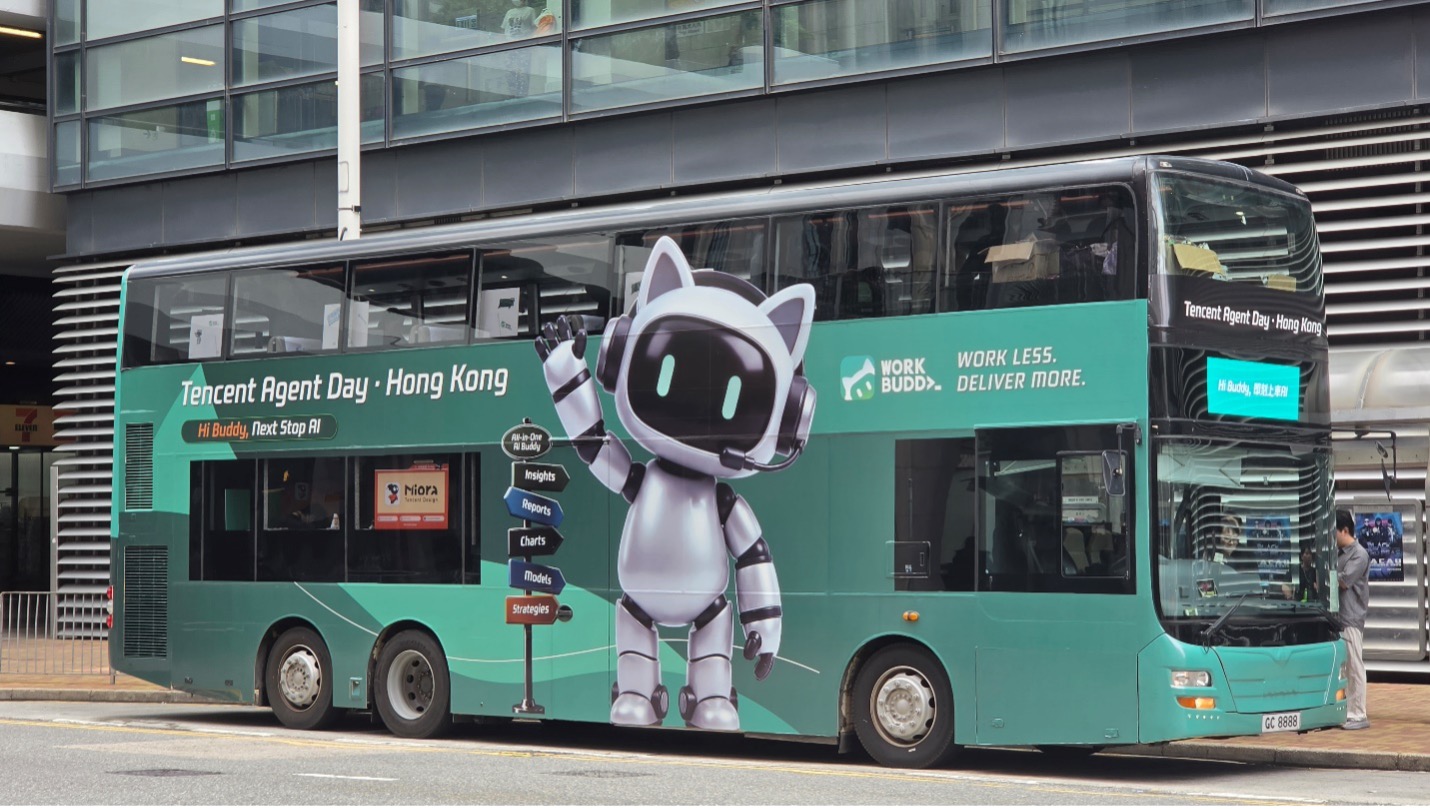
Tencent promots its productivity tool WorkBuddy in Hong Kong in September as part of its global expansion.
Chinese tech giant Tencent is expanding its AI business with a wider international rollout of its AI agent WorkBuddy this month on the heels of the launch of its large language model Hy4 preview in August, underscoring how China is narrowing the AI performance gap with the US.
The Shenzhen-based company said Sept. 3 it expected to release WorkBuddy, a desktop assistant and workspace powered by its Hunyuan LLM, to the rest of the world this month. The product, which can assist with office tasks, first launched in March for users in mainland China followed by limited international launches, including in Hong Kong and Singapore.
It is common for Chinese tech companies to launch international versions of their domestic AI tools adapted for global software ecosystems.
At a Tencent product promotional event in Hong Kong in early September, the company’s product specialist Jiamin Liu said the international version of WorkBuddy was integrated with Notion, Canva and GitHub and is expected to add integrations with other international platforms, such as Slack and Discord.
The team also plans to connect WorkBuddy with Google Workspace and Microsoft’s office applications in the future, Liu said.
According to Statista in July, the top workplace platforms in mainland China are Alibaba’s DingTalk, Tencent’s WeCom and Kingsoft’s WPS Office.
Globally, Microsoft Office 365 and Google Apps account for 58% of the worldwide office software market as of March.
But Tencent’s international competitiveness remains uncertain. While WorkBuddy’s user base grew 135% from July to August, according to performance tracker AICPB, it did not make AICPB’s top 50, recording 14.61 million website visits in August. Alibaba’s Qwen and the Chinese LLM DeepSeek ranked 37th and fifth respectively, with 35 million and 448 million visits. US-based ChatGPT was first with 5.83 billion visits, according to the AI ranking.
Tencent’s latest LLM Hy4 preview helped narrow the performance gap with U.S. models across several benchmarks. According to BenchLM, Hy4 preview ranked fourth on SWE Multilingual, a software engineering benchmark for real-world code issue resolution across multiple programming languages. It trailed three versions of Anthropic’s Claude with Alibaba’s Qwen placing behind it.
Hy4 preview also ranked second on JobBench, an occupational agent benchmark for professional workflows that workers say they most want delegated to AI, behind Meta’s Muse Spark and again followed by Qwen.
The latest iteration showed notable performance improvements over its predecessor Hy3. On paper, it more than doubled the total parameters and active parameters to 770 billion and 49 billion respectively with a one million-token context window, translating to a memory of four full-length novels compared to about one long book for Hy3.
On Arena score, a leaderboard that ranks AI models through blind human preference votes, Hy4 preview performed 5% better than the average model while Hy3 was 5% worse. The model still ranked behind Chinese company Moonshot’s Kimi K3, which performed 6% better than average, although the Hunyuan team said in its release note that they were shipping Hy4 preview with known issues and would keep iterating quickly. Claude Fable 5.1 topped the list, performing 13.7% better than average.
“We are particularly encouraged by the quick iteration cycle of Tencent’s Hy team,” wrote Alex Liu, a research analyst at Bank of America. “Hy4 also demonstrates relatively smaller models could still exhibit superior agentic capability given unique data set acquired from co-design and integration with Tencent’s existing product ecosystem,” he said in a research note.
A Stanford research report showed that the substantial U.S. lead over China in AI performance in 2023 shrank considerably by early 2025 with the leading U.S. model only 2.7% ahead of the leading Chinese model in Arena as of March.
Early 2025 was when DeepSeek began attracting widespread international attention after its AI assistant app overtook ChatGPT in downloads from Apple’s App Store.
Meanwhile, the Hangzhou-based AI lab reported DeepSeek-V3’s training costs of just under US$5.6 million using less powerful H800 GPUs rather than H100 units, while delivering better performance than Claude-3.5 and GPT-4 on several benchmarks.
Stanford University estimated in 2024 that GPT-4 cost US$78 million to train. After DeepSeek reported strong results from a model it said was cheaper, investors dumped tech stocks with Nvidia sinking nearly 17% on Jan 27, 2025.
“If you got a model that has one trillion parameters that is 99% accurate, versus a model that has ten trillion parameters that is 99.5% accurate, the one-trillion-parameter model is the better model because it is smaller, consumes less compute and is nearly as accurate. That is the Chinese model,” said Bhavtosh Vajpayee, the international head of technology research at CLSA Limited, a financial services company based in Hong Kong.
“It’s cheaper because there has been some innovation behind it,” said Vajpayee, adding that the innovation is algorithmic and mathematical.
DeepSeek V4.1-Flash was released on Sept. 10 with further efficiency improvements. Compared with the previous generation, the model’s KV cache, a mechanism that prevents unnecessary calculations, requires only one-fourth as much high bandwidth memory and one eighth as much SSD storage, according to its release notes.
Qwen3.8-Flash-Next released in August also claimed that its training costs were only one nineth of those for Qwen3.7-Plus while delivering improved performance.
“Where you can see a fundamental shift is in some of the infrastructure, hardware technology, the ability to scale applications. I think that kind of ecosystem coming out of China is the most interesting,” said Christopher Hamilton, the Head of APAC ex Japan Client Solutions at Invesco.
“If the technology is better, and it’s more cost-effective, if it’s not going to be the global standard, it’s at least going to be heavily leveraged,” Hamilton added.
Morgan Stanley also said in a research note that China’s AI roadmap is more skewed towards fast speeds and low pricing via model architecture design, algorithm enhancement and infrastructure optimization to gain market share and offset computing power constraints.
The bank argued that better algorithms could help Chinese AI companies compete even if US companies spend more on computing power.
“China’s abundance of data – driven by 1.1 billion internet users, the widespread use of mobile apps, e-commerce platforms, and social media – gives the country a significant edge in AI research,” the bank wrote.

Where you can see a fundamental shift is in some of the infrastructure, hardware technology, the ability to scale applications. I think that kind of ecosystem coming out of China is the most interesting.

Shenzhen marks New Year’s day with parade as tourist spending booms
More than 160,000 people gathered in Shenzhen last week to watch a New Year’s Day parade with more than 1,500 performers on Festival Avenue in Futian, as the city saw an overall boom in tourist spending during the holiday.

Afro Boom: South African Amapiano and Afro House find a beat in China
Shoulders roll, hips sway and feet tap as strangers are united in motion. The only common language at the Shenzhen Afro Pulz Dance Camp is rhythm.

Burned out Chinese teachers struggle with school responsibilities
It’s after 10pm and the city streetlights have long been on in southeastern China. Melisa returns home, exhaustion written on her face. All she wants is a shower