
AI brings former Hong Kong triad figure to digital life
By Liu Honglin, Feng Zhiyue, Zheng Zhixin & Luo Jing
May 2025

Caption.
In partnership with Blockwind News.
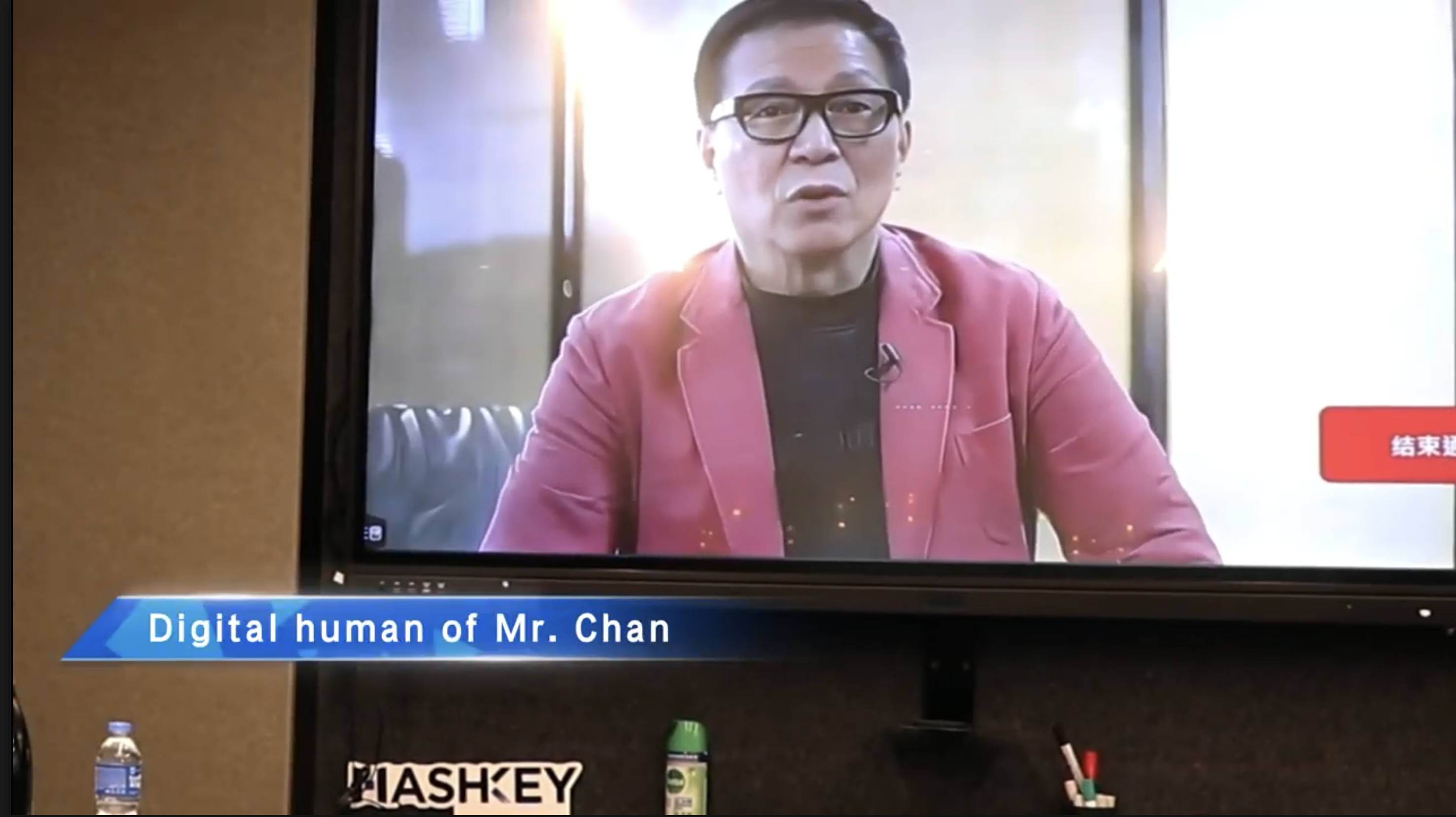
In the heart of Hong Kong’s bustling Exchange Square, a remarkable scene unfolded during a Web3 HK side event. Chan Simchi, once a notorious member of the 14K triad, stood on stage-flanked by his own digital twin.
“I’m Chan Simchi… I used to be a gang member, and then I became involved in drug rehab,” echoed a voice from the digital replica, not the man himself.
Chan stared at his virtual counterpart, a mixture of awe and disbelief on his face. “He looks just like me,” he said.
A Life Reimagined in Digital Form
Chan’s life story is the stuff of Hong Kong cinema legend. After spending eight years addicted to drugs, he devoted himself to helping others break free from addiction.
Now, he works for a church, giving anti-drug talks to teenagers. His experiences have inspired numerous films, including the iconic Young and Dangerous series.
Today, Chan finds himself at the intersection of real-life redemption and cutting-edge technology.
Preserving Legends with AI
The mastermind behind this digital resurrection is Sun Tongjian, CEO of Inovai Tech Corporation. Sun, a lifelong fan of Hong Kong’s mafia films, saw an opportunity to use AI to preserve the stories of the city’s cultural icons. “I love Hong Kong’s mafia films and wanted to use technology to keep their legends alive,” Sun said.
With support from China’s largest programmer community, CSDN, Sun’s team used advanced machine learning algorithms to create a lifelike digital version of Chan. “We analyze and imitate human features and expressions using deep learning and neural networks,” said Yan Hui, a programmer at CSDN.
The result is a digital human capable of mimicking Chan’s appearance, voice, and even mannerisms.
A Tool for Good or for Harm?
For now, the digital Chan is just a prototype. Sun plans to further develop the AI, feeding it more of Chan’s personal data to create a fully realized digital version. His hope is that Chan’s digital twin can one day continue the anti-drug campaign online, reaching youth with a message of hope and resilience.
But the technology is not without risks. Chan himself voiced concerns: “I don’t understand AI, but I hope it can be used to help people overcome addiction. I’m worried that some might use digital humans for scams.”
His fears are justified. As digital human technology advances, so do the risks of misuse. Hong Kong’s Anti-Deception Coordination Centre reported 44,480 fraud cases in 2024-a jump of 11.7% from the previous year. Online fraud now accounts for 68% of cases, including scams involving impersonation and digital deception.
Balancing Innovation and Responsibility
Sun Tongjian remains optimistic. “Technology should help people,” he said. He envisions AI being used for personalized education, virtual therapy, and other positive applications. The AIKind Meetup, organized by AGI Open Network and supported by HashKey and other industry leaders, brought together experts to discuss the future of AI and its impact on society.
“As the exploration of digital humans continues, it is essential to approach this powerful tool with a steadfast commitment to utilizing it for the advancement of humanity,” Sun said.
As Hong Kong’s legends are reborn in the digital age, the city faces new questions about technology, ethics, and the power of human stories-both real and virtual.
Edited by Joe Pan, Editor and Producer of Blockwind News and journalism part-time lecturer. Joe teaches the MAIJS course Reporting Cryptocurrency and Blockchain.

As the exploration of digital humans continues, it is essential to approach this powerful tool with a steadfast commitment to utilizing it for the advancement of humanity.



Shenzhen marks New Year’s day with parade as tourist spending booms
More than 160,000 people gathered in Shenzhen last week to watch a New Year’s Day parade with more than 1,500 performers on Festival Avenue in Futian, as the city saw an overall boom in tourist spending during the holiday.

Afro Boom: South African Amapiano and Afro House find a beat in China
Shoulders roll, hips sway and feet tap as strangers are united in motion. The only common language at the Shenzhen Afro Pulz Dance Camp is rhythm.

Burned out Chinese teachers struggle with school responsibilities
It’s after 10pm and the city streetlights have long been on in southeastern China. Melisa returns home, exhaustion written on her face. All she wants is a shower
