
Women lion dancers take the stage in Hong Kong
Progress has taken decades, but gender bias remains
By Zhou Zhun
December 2025
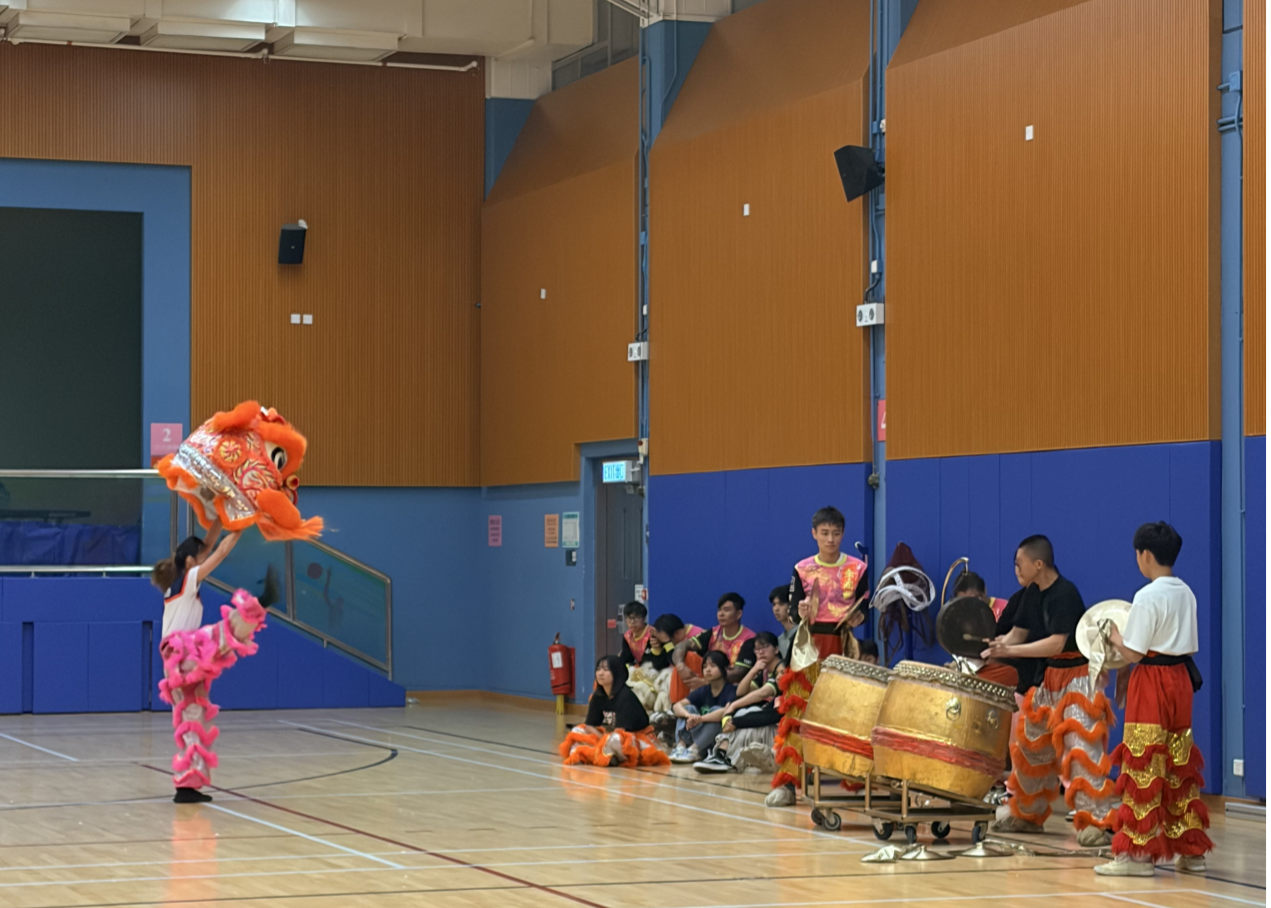
Lam Wing-yan prepares for the Hong Kong Open Dragon & Lion Dance Competition as the female member of Yun Fook Tong who will perform the pole-jumping event.
Yun Fook Tong’s training hall, a Shatin-based lion-dance company, was filled with martial artists hopping on and off plum-blossom poles to the backdrop of deafening drumbeats.
With a competition fast approaching in December, Lam Wing-yan, 26, was the only woman among the three teams practicing on the day. A full-time physiotherapist by day, she has trained in lion dance since the age of 10.
On stage, she lifted the lion head and practiced her steps by the poles while several male team members played drums and gongs for her on the sidelines.
“My childhood dream has been to jump over the poles. It was so cool seeing my senior brothers flying around the poles. I thought girls could do it too. So, I made it my goal and kept training hard,” she said.
This progress has taken many women decades to achieve, but they remain largely invisible during public lion dancing in today’s Hong Kong.
Women have always been part of the lion dance – a blend of acrobatic and martial arts – for their lighter bodyweight, flexibility and rhythmic moves. Performers are clothed in costume mimicking energetic lions to bring good luck, cast away evil spirits and celebrate festivals including the Chinese New Year or the opening of businesses.
As early as 1939, a photograph from the Hon Hsing Athletic Club of Vancouver showed an all-female lion dance team performing to raise funds for war relief in China.
But despite a long history of women in lion dancing, many lion dance companies across Hong Kong today lack female dancers. For one, women are often forbidden to touch the lion head during menstruation for fear of bad luck.
Lee Yun-fook, head coach of Yun Fook Tong, said despite having trained in kung fu and lion dancing with his wife since 1969, she only played background drums during public performances and religious occasions.
Women lion dancers are largely restricted to background drum due to the physical strength difference, said to Keung Wai-hong, the coach of Keung’s Dragon & Lion Dance Team.
Each lion head could weigh up to 5 kg, he said. Lifting throughout the dance is strenuous, especially for the second dancer who must carry the weight of the first dancer and the lion head during plum-blossom poles jumps. Men have a significant physical advantage, said Keung, adding that he often turns down commercial performance requests for an all-women lion dance team, including one from a major global brand.
“I still ask women to take the music part because of their better sense of rhythm,” said Keung, who also coaches City University of Hong Kong’s lion dancing team.
Women’s participation in his team has risen from 20% to 40% since the 1990s, he said. “The turning point came in the 1990s when schools opened extracurricular classes, gradually opening lion dancing for girls,” Lee said.
Women lion dancers dismissed physical concerns saying any shortcomings could be overcome with consistent practice.
“A typical lion head weighs about 10 lb, which is not very heavy. Women can handle it,” Lam said.
Lai Yun-ting, 29, leader of Kwok’s Girls, an all-female team within Kwok’s Kung Fu and Dragon Lion Dance Team, has been practicing lion dance for 17 years.
“If you want to join us, what matters most is genuine interest rather than your physical strength. Because we believe that strength can be built with training,” Lai said.
“In our team, there is no distinction between men and women. Our coach requires the women to move and pack the props, such as the poles and drums, together with the men,” Lai said.
Resistance to women lion dancers can also come from family, one dancer said.
“My parents still thought that girls should be more reserved, with hobbies like learning the piano. They also thought that after my training, I had become bigger and stronger,” Lai said, adding that her parents had never come to watch her during her training or performances.
“I just want to prove myself,” Lai said. “And I am also looking forward to seeing more women join in the future.”
Lai created an Instagram account to post the daily training and performances of Kwok’s Girls, which has attracted more women to join. Currently, they have more than 33,000 followers.
“When the number of female lion dancers increases, competitions can also be divided into two groups for men and women, which will be fairer,” she added.
Not all teams allocate positions based on gender. Some coaches have already begun to change the methods of teaching and scheduling.
Kwok Man-lung, coach of Kwok’s Kung Fu and Dragon Lion Dance Team, said promoting and developing lion dance is his lifelong pursuit. The impact of more women joining is profound, he said.
“Actually Lai wasn’t especially gifted, but she kept training until she nailed the moves, which has rubbed off on people around her,” Kwok said, adding that the women on his team regularly persist through demanding drills.
“Therefore, the participation of female members will not only alert current male members but also attract more public interest in lion dance,” he added.
The coach of Yun Fook Tong said his teaching covers every part and positions are assigned based on personal strengths.
The deeper challenge lies in the difficulty of changing existing ideas about gender norms, experts say. Benedict Rowlett, a sociocultural linguist focusing on gender issues, said that it is almost impossible to escape from gender stereotypes because they pre-exist from birth.
“It is unsurprising that these gender biases still exist in our lives. They are also reinforced by social structures, because from a young age we are taught how men should be and how women should be,” Rowlett said.
“It seems there are more men, so they form a group. It’s difficult for women to fit in,” Chan Ka-kei, one of the young female members in Keung’s Dragon & Lion Dance Team, said.
Linguist Janet Holmes wrote in her book “Gendered Talk at Work” that it is generally the male model of interacting that is more highly valued, to the detriment of women’s communicative behavior, described as deviant.
“Sometimes there are four lions performing together. Three led by men and one by a woman. After the performance is over and the lion heads are removed, the audience realizes and is surprised that there are women involved,” Lam said.
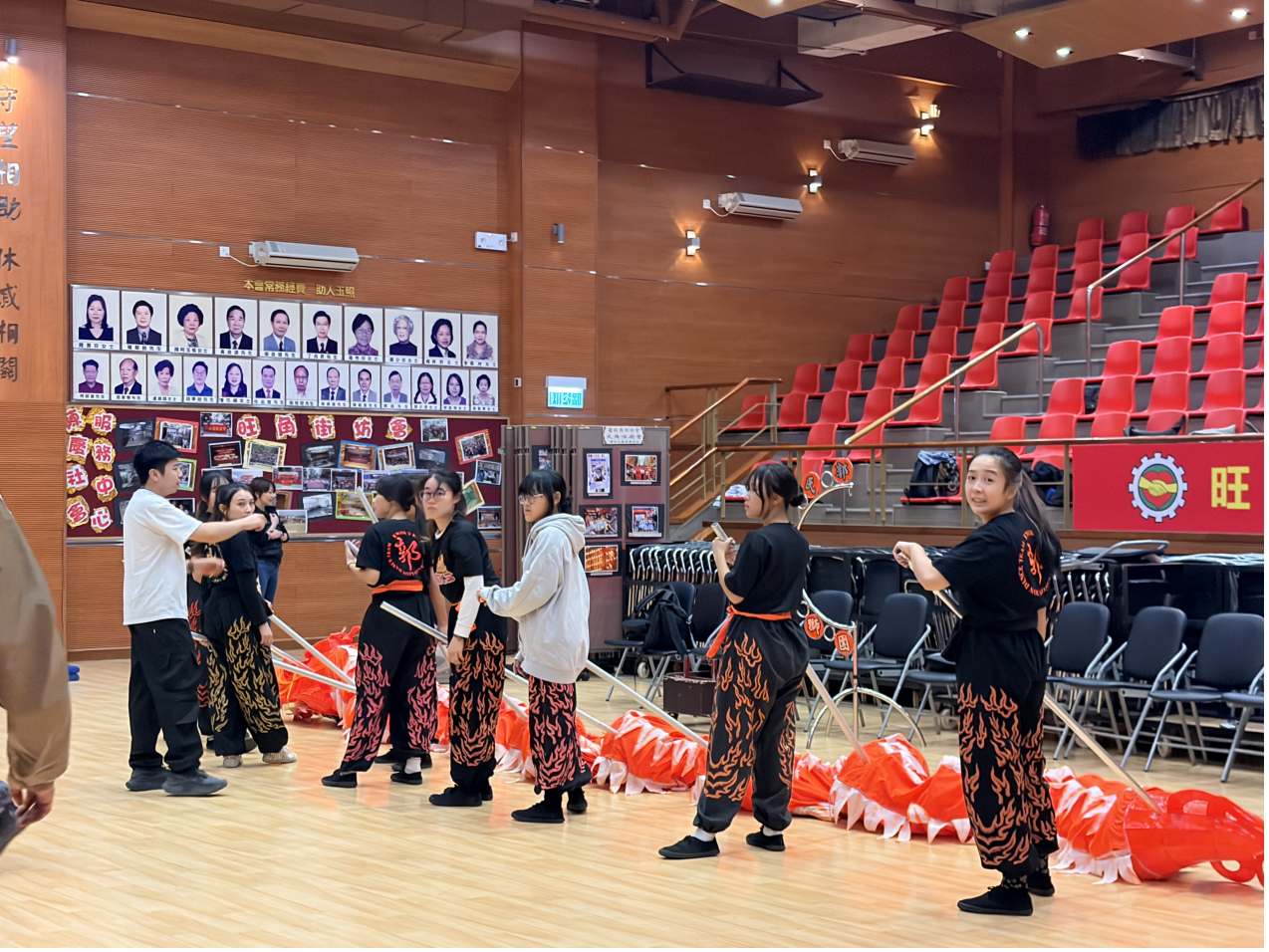
Kwok’s Girls train with a dragon. They are one of the few all-female lion and dragon dance teams in Hong Kong.

“I just want to prove myself…And I am also looking forward to seeing more women join in the future.”


Shenzhen marks New Year’s day with parade as tourist spending booms
More than 160,000 people gathered in Shenzhen last week to watch a New Year’s Day parade with more than 1,500 performers on Festival Avenue in Futian, as the city saw an overall boom in tourist spending during the holiday.
Afro Boom: South African Amapiano and Afro House find a beat in China
Shoulders roll, hips sway and feet tap as strangers are united in motion. The only common language at the Shenzhen Afro Pulz Dance Camp is rhythm.
Burned out Chinese teachers struggle with school responsibilities
It’s after 10pm and the city streetlights have long been on in southeastern China. Melisa returns home, exhaustion written on her face. All she wants is a shower
